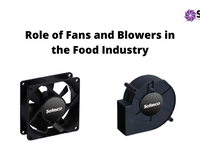

Industrial cooling fans are mission-critical components across medical, telecom, aviation, and electronics manufacturing. Whether you are an OEM engineer specifying fans for a new product line or a procurement manager sourcing for a global supply chain, choosing the right industrial cooling fan system determines equipment lifespan, energy cost, and regulatory compliance.
This guide covers everything you need: fan types, key selection criteria, industry applications, and a quick-reference comparison table backed by Sofasco's 40+ years of manufacturing experience across the USA, Taiwan, China, Korea, and Hong Kong.
What are Industrial Cooling Fans?
An industrial cooling fan is a mechanical device that generates controlled airflow to dissipate heat, remove contaminants, or regulate temperature in industrial equipment and environments. Unlike standard HVAC fans, industrial cooling fans are purpose-built for demanding conditions, high temperatures, high humidity, dust-laden air, and continuous duty cycles.
The primary function is to displace hot air from a system or introduce cooler air, improving thermal management, extending component life, and maintaining safe operating conditions.
The global cooling fan market was valued at approximately USD 15.5 billion in 2024 and is projected to reach USD 29.9 billion by 2034, growing at a CAGR of 10.8%, driven by data centers, electric vehicles, 5G infrastructure, and industrial automation.
Core Components of an Industrial Cooling Fan
Every industrial cooling fan solution, regardless of type, shares the same fundamental assembly:
Motor: (AC, DC, or EC)
The motor is the energy source. Industrial cooling fans run on AC, DC, or EC motors. EC motors offer variable speed control and up to 30% greater energy efficiency than conventional AC motors, making them the preferred choice for modern data centers, telecom equipment, and medical devices.
Rotor Shaft:
The shaft converts electrical energy into mechanical rotation. It is connected to the motor via a hub and transfers torque to the impeller or blade assembly.
Impellers/Blades:
Blades are precision-engineered to move air according to aerodynamic standards. Blade geometry, forward curved, backward curved, or straight, determines airflow volume (CFM), static pressure, and noise level. Biomimetic blade designs are an emerging trend, reducing turbulence by up to 18%.
Fan Casing:
The casing houses and protects the entire assembly from dust, moisture, and mechanical damage. IP-rated casings (IP54, IP65, IP67) are specified for harsh environments, a key requirement in chemical, food processing, and outdoor telecom applications
Fan Mountings / Bearings:
Bearings are the foundation of fan longevity. Ball bearings deliver longer rated life (L10 life > 50,000 hours) and perform better in high-temperature or variable-orientation applications. Sleeve bearings are quieter and lower cost, suited for horizontal mounting and moderate temperatures. Sofasco manufactures both types across its AC, DC, and EC product lines.
These components of the industrial fan assembly remain constant irrespective of the types of industrial cooling fans.
Types of Industrial Cooling Fans: Axial, Centrifugal, EC, Blower & Cross-Flow Explained
Selecting the wrong fan type is the most common and costly mistake in thermal design. Here is a plain-language breakdown of each type:
Axial Fans:
Axial fans move air parallel to the fan axis. They generate high airflow volumes (CFM) at relatively low static pressure, making them the go-to choice for electronics cooling, ventilation panels, and server rack cooling. Sofasco's DC axial fans are available in standard and dust-proof configurations for harsh-environment OEM applications.
Centrifugal Fans ( Radial fans ):
Centrifugal fans (also called radial fans) move air perpendicular to the fan axis. They generate higher static pressure than axial fans, critical for HVAC systems, boiler surroundings, filtration units, and ducted airflow applications. Available in forward-curved and backward-curved blade configurations.
EC Fans (Electronically Commutated)
EC fans combine the efficiency of a DC motor with AC power input using integrated electronics. Key advantages: variable speed via 0-10V or PWM signal, up to 70% reduction in power consumption at partial loads, and smart integration with building management systems (BMS) and IoT platforms. EC fans are rapidly becoming the standard for data centers, telecom infrastructure, and medical equipment where energy regulation compliance is required.
Cross-flow Fans:
In the cross-flow fans, the air flows in a tangential direction to the fan axis. This is why it is also known as tangential fans. They feature a long cylindrical shape with an impeller that spans the entire width of the fan.
Blowers (Centrifugal Blowers):
Industrial blowers use impellers instead of blades and are optimized for high-pressure, directional airflow. They excel in chip cooling, duct exhaust systems, and applications requiring airflow against high resistance. Blowers re-utilize kinetic energy from the impeller to maintain airflow efficiency, reducing motor power draw compared to axial fans in high-resistance environments.
Many manufacturers offer the option to customize these industrial cooling fans to meet specific requirements.
Industrial Cooling Fan Comparison: Quick-Reference Table
Use this table to match fan type to your application requirements:
| Fan Type | Airflow Profile | Power Type | Best For |
|---|---|---|---|
| Axial Fan | High CFM / Low static pressure | AC or DC | Ventilation, electronics cooling |
| Centrifugal Fan | High static pressure / Moderate CFM | AC or DC | HVAC, filtration, boilers |
| EC Fan | High efficiency / Variable speed | EC (brushless) | Data centers, telecom, medical |
| Cross-flow Fan | Uniform airflow / Compact form | AC or DC | Enclosures, appliances |
| Blower | High pressure / Directional airflow | AC or DC | Chip cooling, duct exhaust |
How to Choose the Right Industrial Cooling Fan for Your Application
Follow these five criteria when specifying an industrial cooling fan:
- Calculate the heat load (watts) your system generates and the airflow needed to dissipate it. Use the formula: CFM = (3.16 × Watts) / ΔT°F.Airflow requirement (CFM):
- Measure the resistance to airflow in your enclosure or duct. High-resistance applications (filter screens, long ducts) need centrifugal fans or blowers; open applications suit axial fans. Static pressure:
- Specify IP54 or higher for dusty/humid environments. For medical or cleanroom applications, select fans with UL-certified components and RoHS-compliant materials. Environment rating:
- Match fan voltage to your system: 12V DC (embedded electronics), 24V DC (industrial controls), 48V DC (telecom), 115V/230V AC (HVAC, industrial).Voltage and power supply:
- Medical, office, and residential-adjacent applications have strict acoustic limits. Low-noise fans with backward-curved blades or EC motors consistently outperform standard axial fans on dBA ratings.Noise level (dBA)
Applications of Industrial Cooling Fans
Industrial cooling fans are used across critical industries where reliability and thermal control are essential:
- Medical Equipment: Low-noise, long-life DC and EC fans for imaging systems, ventilators, and lab devices.
- Telecommunications: High-reliability, IP-rated fans for base stations and 5G infrastructure, typically using 48V DC systems.
- Aviation & Defense: Custom fans built to withstand vibration, extreme temperatures, and meet MIL-SPEC standards.
- Electronics & IT: Axial fans and blowers for servers, UPS, and power supplies; EC fans enable efficient, controlled cooling.
- HVAC & Enclosures: Centrifugal and AC axial fans for air handling units, control panels, and ducted systems.
- Energy & Industrial: IP65+ dust-proof fans with corrosion resistance for oil & gas, chemical, and outdoor applications.
However, these benefits of industrial cooling fans can only be reaped if quality equipment is installed. This is because the quality of industrial cooling fan systems highly impacts the airflow and cooling in a facility. Thus, you must buy industrial cooling fans from trusted manufacturers like Sofasco. This company has been supplying all types of industrial fans, since 1981, all over the globe such as, ac and dc cross flow fans, axial fans, centrifugal fans, blowers, dust-proof fans and more.
Find the Right Industrial Cooling Fan solutions for Your Application
Sofasco's engineering team has supported OEM thermal design across medical, telecom, aviation, and industrial electronics for over four decades. Whether you need standard catalog fans or a fully custom-engineered solution, we can help.
• Use our Product Selector Guide at sofasco.com/pages/product-selector-guide to match fan specs to your requirements.
• Request a custom quote for OEM volumes, modified specifications, or custom-engineered designs.
• Call our team at 1-800-356-4159 or email sofasco@sofasco.com for engineering support.
• Download CAD files for integration into your product design at sofasco.com/pages/cooling-fan-cad-files.
FAQs
Q: What is the difference between an axial fan and a centrifugal fan?
An axial fan moves air parallel to its axis and delivers high airflow at low pressure, while a centrifugal fan moves air perpendicular to the intake and generates higher static pressure for ducted or restricted systems.
Q: What IP rating should I specify for industrial cooling fans in harsh environments?
Use IP54 for dust and light moisture, IP65 for heavy dust and water jets, and IP67 for temporary immersion. Most industrial applications require IP54-IP65 rated industrial cooling fans.
Q: Can industrial cooling fans be customized for specific OEM requirements?
Yes, industrial cooling fans can be customized for voltage, airflow, speed control (PWM), connectors, IP rating, and form factor to meet specific OEM application requirements.
Q: What is the difference between an industrial fan and a normal fan?
An industrial cooling fan is designed for continuous operation, higher performance, and harsh environments, while a normal fan is built for general use with lower durability and limited operating conditions.
Q: How long do industrial fans last?
Industrial cooling fans typically last 20,000-70,000+ hours, depending on bearing type and operating conditions; ball bearing fans offer the longest lifespan.