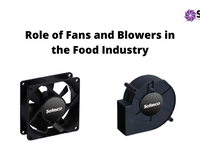

Industrial blowers are air-moving devices used to deliver a controlled volume of air or gas against the resistance created by a system. Common designs include centrifugal blowers, axial fans and positive-displacement blowers. The right solution depends on the required airflow, pressure, operating temperature, air characteristics, electrical requirements, physical constraints and application.
For engineers and OEMs, blower selection should begin with the required operating point airflow at a defined pressure not simply the maximum airflow listed for a blower. Fan performance is commonly evaluated in terms of airflow, pressure, power, speed and efficiency.
What Is an Industrial Blower Fan?
An industrial blower fan is a motor-driven air-moving device designed to deliver controlled airflow through equipment, ductwork, enclosures, and industrial systems. It is selected to provide the required airflow while overcoming resistance from components such as filters, heat exchangers, grilles, and narrow air passages.
Industrial blower fans are commonly used for equipment cooling, HVAC, ventilation, exhaust, process airflow, dust handling, and OEM thermal management. They are available in configurations such as centrifugal and axial designs, with AC, DC, and EC motor options for different application requirements.
The key factors when selecting an industrial blower fan are airflow, pressure, operating conditions, electrical requirements, and available space.
What Are the Main Types of Industrial Blowers?
Industrial blowers can broadly be grouped into centrifugal, axial, and positive-displacement designs.
1. Centrifugal fans
Centrifugal blower fans draw air into the impeller center and discharge it radially at a 90-degree angle. These blowers are designed for medium-to-high static pressure applications where airflow must overcome resistance from ductwork, filters, heat exchangers, or industrial process systems.
Because of their pressure-generating capability, centrifugal blowers are widely used in HVAC systems, industrial ventilation, dust collection, electronics cooling, and process airflow applications.
Forward curved blowers are designed to deliver high airflow volume at lower static pressure with quieter operation. They are widely used in air handling units (AHUs), commercial HVAC systems, and clean-air ventilation applications where compact design and smooth airflow performance are required.
Backward curved blowers provide higher operating efficiency and lower energy consumption compared to forward-curved designs. These blowers are commonly selected for industrial ventilation, cleanroom airflow systems, and energy-efficient process cooling applications requiring stable airflow under varying pressure conditions.
Radial blade blowers use straight, rugged impeller blades designed for abrasive and particulate-heavy environments. These blowers are commonly used in dust collection systems, mining operations, metal fabrication facilities, and pneumatic conveying applications where durability and pressure stability are critical.
2. Axial fans
In axial fans, the blades extend radially outward and the air moves in the parallel direction of the rotational axis of the fan wheel. The air once taken spins off from the central spot to the outer periphery, with the help of the blades. Air pressure is created aerodynamically by the fan blades when pushing it out. DC Axial blowers have a compact design and are more suitable for low pressure applications. They can be efficiently used in small-sized exhaust applications with a definite amount of air, dirt, or smoke.
-
Propeller Fans
Propeller fans are commonly used in open-air industrial ventilation systems, cooling towers, agricultural airflow systems, and warehouse exhaust applications. They provide high airflow volume in low-resistance operating environments.
Tube-axial fans incorporate a cylindrical housing that improves airflow direction and pressure handling compared to standard propeller fans. These fans are widely used in industrial duct systems, tunnel ventilation, and commercial HVAC airflow applications.
Vane-axial fans use guide vanes to improve airflow efficiency and static pressure performance. They are commonly used in power generation facilities, industrial process ventilation systems, and high-capacity HVAC applications where controlled directional airflow is required.
3. Positive Displacement (PD) Blowers
Positive displacement blowers deliver a fixed volume of airflow regardless of system pressure variations. Unlike centrifugal or axial fans, PD blowers are designed for industrial processes requiring continuous airflow, precise pressure control, and stable air delivery.
-
Rotary Lobe Blowers
Rotary lobe blowers use synchronized rotating lobes to move air consistently through industrial systems. These blowers are commonly used in wastewater treatment aeration, pneumatic conveying systems, vacuum processing, and industrial gas handling applications.
-
Helical Screw Blowers
Helical screw blowers compress air using intermeshing screw rotors, providing smoother airflow, improved energy efficiency, and reduced operating noise. They are widely used in continuous-duty industrial processing and energy-efficient compressed airflow systems.
-
Regenerative (Ring) Blowers
Regenerative blowers, also called ring blowers, generate clean, oil-free airflow using repeated air acceleration inside a ring-shaped housing. These blowers are commonly used in packaging equipment, medical systems, vacuum handling applications, aquaculture aeration, and electronics manufacturing environments requiring compact continuous airflow solutions.
Applications of Industrial Blower Fans
- HVAC & Air Handling Systems: Centrifugal blower fans maintain airflow through ductwork, filters, coils, and ventilation systems where static pressure losses occur. Backward-curved centrifugal blowers are commonly used in air handling units (AHUs), rooftop HVAC equipment, and commercial ventilation systems because they provide stable airflow performance with higher operating efficiency.
- Data Centers & Telecom Systems: High-static-pressure DC centrifugal blowers provide directional airflow for server racks, telecom enclosures, network switches, and power supply cooling systems. These blowers maintain thermal stability in compact electronic environments where heatsinks, filters, and restricted airflow paths increase system resistance. Recommended to use DC Centrifugal Blower Fans or High Static Pressure DC Fans.
- Industrial Dust Collection: Dust collection and material handling systems require blower designs capable of handling particulate-laden airflow without significant performance degradation. Radial blade centrifugal blowers are widely used in woodworking, mining, cement processing, and metal fabrication because the straight-blade design resists particulate buildup and improves durability in abrasive operating environments.
- Manufacturing & Process Ventilation: Industrial blower fans support welding fume extraction, process drying, combustion airflow, heat removal, and chemical exhaust applications. Backward-curved and radial centrifugal blowers are commonly selected for continuous-duty manufacturing systems where stable airflow and resistance handling are critical for operational safety and process reliability.
- Electronics & Control Panel Cooling: Industrial control cabinets, automation systems, battery enclosures, and power electronics require compact high-pressure airflow solutions for thermal management. DC blower fans provide focused airflow in enclosed systems where restricted ventilation paths can cause localized heat buildup and component failure.
- Food Processing & Pharmaceutical Applications: Hygienic airflow systems are essential in cleanroom ventilation, food processing equipment, and pharmaceutical manufacturing environments. Washdown-capable or IP-rated centrifugal blowers with corrosion-resistant construction help maintain clean airflow, moisture resistance, and contamination control in sensitive processing applications.
- Power Generation & Energy Systems: Industrial blower systems are used in combustion airflow, transformer cooling, battery energy storage systems, and turbine ventilation applications where continuous airflow stability is required. High-efficiency centrifugal and EC blower systems help maintain thermal control while reducing operating energy consumption in industrial power environments.
- Automotive & EV Charging Systems: EV charging stations, battery thermal management systems, and automotive electronics require compact blower systems capable of maintaining airflow in restricted enclosures with elevated thermal loads. DC centrifugal blowers are commonly used because they provide high static pressure airflow for targeted cooling in compact electronic assemblies.
Which Industrial Blower Is Best for Each Application?
There is no single blower that is best for every application. A more useful approach is to match the application requirements with the blower's characteristics.
| Application requirement | Design that may be considered | Key factors to verify |
|---|---|---|
| Ducted HVAC airflow | Centrifugal | Required airflow and system pressure |
| Restricted electronics cooling | Compact centrifugal/DC blower | CFM, static pressure, size and voltage |
| High-volume open ventilation | Axial | Airflow, pressure and installation |
| Filtered enclosure cooling | Centrifugal | Filter pressure drop and operating point |
| Particulate-laden airflow | Application-specific centrifugal design | Particle characteristics, temperature and materials |
| Variable-speed thermal management | EC/DC solution where appropriate | Control method, operating range and efficiency |
| Compact OEM equipment | DC/EC centrifugal or other suitable design | Dimensions, voltage, controls and thermal requirements |
| Specialized process airflow | Application-specific solution | Gas properties, temperature, pressure and duty cycle |
These are starting points, not universal rules. The manufacturer's performance data and the actual application requirements should determine the final selection.
How to Choose the Right Industrial Blower Fan
Use these four engineering criteria to specify the correct unit for your application:
Step 1 - Calculate Airflow (CFM) Requirements
Use the heat dissipation formula: CFM = (3.16 × Heat Load in Watts) ÷ Temperature Rise in °F. For ventilation applications, calculate based on air changes per hour required by the space volume.
Step 2 - Assess Static Pressure
Measure system resistance from ductwork, filters, and heat exchangers. High-resistance systems (above 0.5 inWG) require centrifugal blowers. Open or lightly obstructed paths suit axial fans. Elevation above sea level reduces air density and must be factored into pressure calculations.
Step 3 - Select Motor Type
Choose AC (115V/230V) for fixed-speed industrial applications with standard power infrastructure. Choose DC (12V/24V/48V) for OEM, battery-powered, or low-voltage embedded applications. Choose EC (electronically commutated) when variable-speed operation, PWM or 0-10V control, and IE4-equivalent energy efficiency are required EC fans reduce power consumption by up to 70% at partial loads.
Step 4 - Define Environmental Requirements
Specify IP rating for moisture and dust ingress (IP54 standard, IP55/IP65 available from Sofasco). Confirm operating temperature range against ambient conditions. For corrosive or chemically aggressive environments, specify housing and impeller material accordingly.

How To Read a Blower Performance Curve?
A performance curve shows how an industrial blower fan performs at different airflow and pressure conditions. It helps determine whether a blower can meet the application's required operating point.
What to Check on a Performance Curve
- Airflow: Required CFM or other flow rate.
- Pressure: Static or total pressure the blower must overcome.
- Operating point: Where required airflow and pressure intersect.
- Speed: RPM at which the curve applies.
- Power: Energy required at the operating condition.
- Efficiency: Blower efficiency at the selected point.
- Test conditions: Temperature, air density, and other conditions used for testing.
Key takeaway: Don't select a blower based on maximum CFM alone. Check whether it can deliver the required airflow at the required pressure under your actual operating conditions.
AC, DC, or EC: Which Blower Technology Should You Choose?
The appropriate motor technology depends on the equipment's electrical architecture and control requirements.
- AC blowers: Suitable when the application has a compatible AC power supply.
- DC blowers: Useful for equipment designed around DC power and common in OEM applications.
- EC blowers: Incorporate electronic commutation and can support advanced speed-control options on applicable models.
Sofasco offers AC, DC, and EC fan and blower technologies for different cooling and air-moving applications.


When Should You Consider a Custom Industrial Blower?
A standard blower is usually the simplest option when its performance, dimensions, electrical configuration, and environmental specifications match the application.
Customization becomes useful when the application has requirements such as:
· Non-standard dimensions
· Specific airflow or pressure
· Special voltage
· Custom mounting
· Particular control requirements
· Defined noise requirements
· Specific IP protection
· Specialized bearing requirements
· OEM integration constraints
Sofasco provides custom-engineered cooling solutions covering requirements such as dimensions, airflow, voltage, bearing type, IP rating, noise, mounting, and control features.
For OEM development, CAD resources can also help integrate blowers and fans into equipment designs.
FAQs
Q1. What is the difference between a blower fan and a regular fan?
A blower fan generates higher static pressure and directs airflow through restrictive systems such as ducts, filters, and heat exchangers. Standard fans are primarily designed for open-air circulation.
Q2. What are centrifugal blower fans used for?
Centrifugal blowers are used in HVAC systems, industrial ventilation, process cooling, dust collection, electronics cooling, and fume extraction applications where airflow must overcome system resistance.
Q4. When should you use a centrifugal blower instead of an axial fan?
Centrifugal blowers are typically used when airflow must move through restrictive airflow systems involving ductwork, filters, or back pressure. Axial fans perform best in low-resistance environments.
Q5. What industries use industrial blower fans?
Industrial blower fans are widely used in manufacturing, HVAC, electronics cooling, telecom infrastructure, mining, food processing, industrial automation, and medical equipment applications.