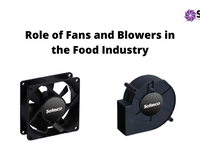

An axial flow fan is a type of industrial fan used to cool machines and equipment which heat up after use. Axial flow fans are the type of compressor, that produces airflow parallel to the axis, thus the name. These fans are equipped with impellers, which suck the air in and discharge in the same direction of the axis.
There are AC as well as DC axial flow fans. It may be designed in different ways, such as with a duct or a mounting ring, and so on, depending upon the requirement. So, there are different standard designs that can be customized based on your device and installation type. The materials and accessories used for the fan are decided on these and other physical factors such as the environment it would be exposed to, temperature, moisture, pressure, and so on. This post discusses various designs of axial flow fans, and general features.

How Does an Axial Flow Fan Works?
The axial flow fan's working principle is based on the aerodynamic lift generated by its blades. As the motor rotates the impeller, the aerofoil-shaped blades create a pressure differential between the upstream and downstream sides.
- Air Intake: Air enters the fan housing parallel to the shaft axis.
- Energy Transfer: The rotating blades impart kinetic energy to the air. The angle of the blades known as the blade pitch, determines the volume of air moved (CFM) and the static pressure the fan can overcome.
- Discharge: The air exits the fan in the same axial direction.
In advanced configurations, such as vane axial flow fans, fixed guide vanes are used to straighten the rotational "swirl" of the air. This process recovers kinetic energy that would otherwise be lost to turbulence, converting it into useful static pressure and significantly increasing the fan’s operating efficiency.
Types of Axial Flow Fans
Understanding axial flow fan types is essential for matching a fan to its specific system resistance and airflow requirements. There are three primary configurations used in the industry:
1. Propeller (Panel) Axial Fans
The simplest and most cost-effective design consists of a motor and a propeller mounted within a mounting ring or plate. Propeller axial fans are commonly used in open-air ventilation and general air circulation applications where low static pressure and high airflow are required.
- Performance: High airflow at near-zero static pressure.
- Applications: Free-air ventilation, wall-mounted exhaust, and general air circulation.
- Limitation: These fans cannot handle significant resistance from ducts or filters.
2. Tube Axial Flow Fans
In this design, the impeller and motor are housed within a cylindrical casing. This housing helps focus the airflow and allows the fan to be integrated into ductwork.
- Performance: Higher efficiency than propeller fans; capable of handling moderate static pressure levels in ducted airflow systems.
- Applications: Fume extraction, process cooling, and ducted ventilation systems.
3. Vane Axial Flow Fans
A vane axial flow fan is essentially a tube axial fan with the addition of downstream or upstream guide vanes.
- Performance: The most efficient axial design (Vane axial designs generally offer higher aerodynamic efficiency and improved pressure performance compared to standard propeller fans.) It can handle high-pressure ducted systems that would otherwise require a centrifugal fan.
- Applications: HVAC variable air volume (VAV) systems, industrial drying, and mine ventilation.
4. Compact Axial Flow Fans
Compact axial flow fans are widely used in electronics cooling, telecom systems, control panels, and other space-constrained thermal management applications.
Components of Axial Flow Fan
The most basic part of an axial flow fan is the motor. Other than that it has ball bearings, blades, and impellers. The fan has a housing or an enclosure which protects it from external damage, spillage, shock, vibration, and so on. The enclosure is metallic and made of steel, aluminum, or alloys. The impellers are usually made of cast aluminum with black paint, thermoplastic, or steel, and designed to be corrosion resistant. The thermoplastic impellers are generally not considered ideal for commercial applications, so they are usually reserved for residential applications. The propellers feature blades. There can be 2 to 20 blades on the propellers. The fan is connected to a motor drive, which is usually placed in a housing parallel to the direction of airflow. The blades are usually made of aluminum. These fans are designed to be resistant to extreme temperatures, flames, shock, corrosive materials, and so on. A few common accessories of this fan include suitable connecting points, silencer, protection grill, counter flange, vibration controller, feet for the required positioning, and a variable inlet vane.
Additional Axial Fan Assembly Considerations
In industrial axial fan assembly design, component selection directly affects airflow performance, operational reliability, and service life. Factors such as blade geometry, motor efficiency, bearing configuration, and housing design influence airflow stability and cooling performance across different operating environments.
Modern axial cooling fan assemblies are commonly engineered for applications requiring continuous airflow, low noise operation, compact installation, and long operational life.
Design of Axial Flow Fans
As mentioned, the fan has various standard designs. Here are a few pointers:
- The fans may be duct mountable or wall mountable.
- Ducted fans have a duct through for a seamless airflow.
- The ring mountable fans allow the airflow from one big enough area to another; so, it is suitable for large spaces.
- The circulator fan has rotating impellers, which are typically used in ceiling fans.
- Axial flow fans offer large airflow rates at low pressures because of their working principle. The blades of these fans draw air parallel to its axis and move it in the forward in the same direction within the axis of the fan.
Some General Characteristics of Axial Flow Fans
These fans are typically used for sucking hot air from heat generating machines, trenches, and so on. They are also used for ventilation in enclosed spaces. These fans find a great application in quiet zones. Here are some general features of axial flow fans.
- These fans have a wide size range from 25mm to 250mm.
- These fans usually have ball or sleeve bearings which can last up to as high as 50,000 hours and at reasonably high temperatures.
- Their operating range is usually from -10 to +70, depending upon the bearing type.
- They operate quietly without noise, and have a good dielectric strength.
- They require minimal power input to operate.
- Apart from cooling industrial equipment, they find applications in diverse segments such as snow making machines, vending machines, refrigeration systems, HVAC systems, and so on.
Applications of Axial Flow Fans
Axial fans are generally used for cooling applications like the ones mentioned below:
- Process cooling in systems or machinery
- Spot cooling of transformers and generators and industrial equipment
- Ventilation in warehouses, factories, foundries, laundries, garages, equipment rooms, and engines
- Cooling work areas where heat is produced
In addition to this, industrial axial fans are also used for removing toxic gases and fumes from:
- Paint spray booths
- Welding booths
- Kilns, steel mills, and forges
- Paper mills or industrial parts washers
- HVAC and ventilation systems
- electronics and telecom cooling
- industrial equipment cooling
- server and control cabinet cooling
- EV charging systems
- power conversion equipment
- industrial exhaust systems
Benefits of Using Industrial Axial Flow Fans
Efficient Airflow:
Industrial axial flow fans assure efficient airflow, which is why they are used in cooling towers and exhausts. The cooling towers cannot dissipate heat if the airflow is not proper. The water system and fill material inside these fans operate properly due to a consistent airflow from the cooler fan, which is an axial fan. The axial fans can produce a large volume of air at a regular pace, and they also ensure even air circulation due to the airfoil blades.
Variable Speed:
The speed of axial flow fans can be easily altered to suit the needs of the cooling tower or exhaust fans. The fans will continue to produce high airflow even if the speed is decreased. Against this, decreasing the speed can have a direct impact on the airflow of centrifugal fans.
Durable Construction:
Most industrial axial fans are made from aluminum, which makes them durable, reliable, lightweight, and user-friendly at the same time. Sometimes they are also made of stainless steel, which improves their performance in harsh environments. Many manufacturers provide industrial axial fans equipped with spark-resistant and cast aluminum-made propellers, which assures their safety in high-temperature applications. Their durable construction is one of the prime reasons for employing these fans in ships, aircraft, helicopters, and hydrofoils.
Quick Maintenance:
Axial fans possess simpler designs than other industrial fan types. These fans have simple and open designs. Thus, any operational issues that arise can be easily identified and rectified. This is one of the reasons why these fans are widely used in industrial cooling and exhaust applications.
Improved Lifespan of Mechanical Components:
These fans possess compact footprints and lightweight designs than their earlier counterparts, which helps improves the lifespan of different mechanical components in it. Generally, the axial fans have improved lifespan than other industrial fans due to their high mechanical strength and optimal designs.
Quieter Than Most Other Industrial Fans:
Industrial axial flow fans produce low mechanical noise than conventional fans. This makes it an ideal choice for applications where noise can be a big concern.
If you are an OEM and have newly installed equipment which require axial flow fans, ensure you source them from a reliable manufacturer and supplier. Also, ensure they have features which meet your specifications. Sofasco designs, develops, and manufactures AC and DC axial fans in a huge size range, along with other integrated cooling solutions which can be customized to suit your requirements.
Frequently Asked Questions
Q1. What is an axial flow fan?
An axial flow fan is a fan designed to move air parallel to the fan shaft, typically providing high airflow at low to moderate static pressure.
Q2. How does an axial flow fan work?
Axial flow fans use rotating blades to generate airflow in the axial direction through aerodynamic lift and pressure differences.
Q3. What are axial flow fans used for?
Axial flow fans are commonly used in ventilation systems, electronics cooling, HVAC equipment, telecom enclosures, and industrial airflow applications.
Q4. What is the difference between axial fans and centrifugal fans?
Axial fans move air parallel to the shaft and are generally used for high airflow applications, while centrifugal fans generate higher pressure for ducted systems with greater resistance.
Q5. What is the difference between axial and mixed flow fans?
Axial fans move air parallel to the shaft and are designed for high airflow with low static pressure applications such as cooling and ventilation. Mixed flow fans combine axial and centrifugal airflow characteristics, allowing them to handle higher static pressure while maintaining efficient airflow in ducted and HVAC systems.
Conclusion
Maximizing the performance of your thermal management system begins with selecting a high-quality industrial axial flow fan. At Sofasco, we combine two decades of engineering expertise with UL-certified manufacturing to deliver fans that meet the rigorous demands of the aerospace, medical, and telecom industries.
Ready to optimize your cooling system?