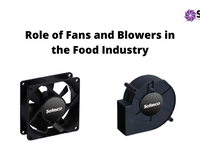

Axial fans are one of the common types of industrial fans used today. These fans are used for applications that demand a larger flow rate at a small pressure gain. Over the years, various types of axial fans or axial flow fans have gained popularity. Tube axial fans are one of them. These fans are nowadays used in a wide range of applications from drying to cooling to ventilation and air supply for any machine or industrial process. Owing to the distinct advantages gained from their typical construction, these fans have gained immense traction. This post discusses everything you may want to know about these fans.
Tube axial fans, also referred to as tubeaxial fans in industry literature, are distinct from open propeller fans and vane axial fans in both construction and performance capability, a distinction this guide covers in detail.
The three common types of axial fans are:
- Propeller fans - open-frame design, no housing, low static pressure; used in open-area ventilation and agriculture.
- Tube axial fans - propeller enclosed in a cylindrical tube housing, no guide vanes; suited for ducted, moderate-pressure applications.
- Vane axial fans - cylindrical housing with downstream stationary guide vanes; highest static pressure capability among axial fan types; used in demanding HVAC duct systems.
What is Tube Axial Fan?
A tube axial fan is an inline industrial fan that houses a disk-type propeller or impeller inside a cylindrical tube housing. Unlike a vane axial fans, it has no straightening guide vanes downstream of the impeller, making it simpler in construction, lower in cost, and well-suited to high-volume, low-to-moderate static pressure applications such as exhaust ventilation, process cooling, and electronics thermal management.
A tube axial fan comprises a disk-type wheel or propeller contained within a cylindrical tube-like structure. This fan is closely related to the vane axial fan, another popular axial flow fan variant, with the key difference being the absence of straightening guide vanes. The propellers are arranged with a small tip clearance gap between the housing and the blade tip, which is carefully engineered to balance airflow efficiency with mechanical clearance. This tip clearance gap directly influences fan efficiency; a tighter clearance improves static pressure but increases manufacturing precision requirements.
Air enters the fan axially (parallel to the shaft), the rotating propeller imparts kinetic energy to the airstream, and the air exits in the same axial direction making these fans well-suited for in-line duct installations. Because there are no guide vanes to recover the rotational energy in the discharge airflow, tube axial fans produce moderate swirl in the discharge a trade-off accepted in exchange for lower cost and simpler construction.
Components of Tube Axial Fan
Here is a detailed explanation of a few important components of tube axial fans:
Propellers:
These fans are fitted with propellers made of cast aluminum or heavy-duty steel. Sometimes propellers are also made of stainless steel. All these materials can withstand high temperatures, which makes them a suitable choice for a propeller. The propeller features a hub to which the blades are welded. These blades are welded precisely at angles ranging from 30° to 50°. Some manufacturers also provide customization choices when it comes to angles. Usually, propellers are balanced statically to ensure their smooth operation.
The hub-to-tip ratio of the propeller is a key design variable. A larger hub-to-tip ratio increases the fan's pressure-handling capability at a given speed, allowing the same fan frame to be optimised for different operating points.
Fan Housing:
The housing is the structure that hosts the impeller. It also serves as the welded base of the engine, which supports the axial airflow. Among various factors, the performance of the tube fans depends on the design of the impeller and the shape of the housing. The cylindrical housing is also what qualifies these fans as tube axial duct fans designed for direct integration into ductwork or equipment enclosures.
Bearings:
These fans may be equipped with ball bearings or roller type bearings.
Motor:
A variety of single-phase and three-phase motors are used in tube axial fans, selected based on required horsepower, operating voltage, and environment. NEMA-frame motors are common in North American industrial applications. Variable frequency drives (VFDs) can be paired with tube axial fans to provide speed control, enabling airflow adjustment without motor replacement, a significant advantage for process control applications.
Inspection Door:
An inspection door is a small access panel on the housing casing, primarily used during preventive maintenance operations to inspect internal components without full disassembly.
Belt or Pulleys:
In belt-driven configurations, sheaves and V-belts transmit power from the motor to the fan shaft. Belt selection is based on factors including horsepower, motor RPM, and desired fan speed. Belt-driven designs allow fan speed adjustment by changing sheave sizes, providing operational flexibility not available in direct drive units.
Direct or Belt Driven:
Tube axial fans are available in two drive configurations. In belt-driven designs, the propeller is mounted on a separate fan shaft connected to the motor via sheaves and V-belts. In direct-drive designs, the impeller is mounted directly on the motor shaft, eliminating belt maintenance. Tube axial fans of both types are well-suited to applications demanding large airflow at low static pressures.
Many manufacturers offer these fans in all steel or aluminum construction.
Types of Tube Axial Fans
As said before, there are two types of tube axial fans – direct drive tube axial fan and belt driven tube axial fan.
Direct Drive Tube Axial Fans:
Direct drive tube axial fans are ideal for applications where operational efficiency and low noise are priorities. These fans are equipped with precision-designed, accurately balanced aluminium spark-resistant propellers capable of handling air laden with pigments and condensable fumes. Applications include heat control, smoke and heat removal, general ventilation, and process ventilation. Direct drive tube axial fans require less ongoing maintenance than belt-driven variants, since there are no belts or sheaves to inspect or replace.
Belt Driven Tube Axial Fans:
Belt driven tube axial fans house the drive mechanism outside the airstream, isolating the motor and belt assembly from the process air. These fans are widely used for general and industrial ventilation, particularly for removing contaminated or moisture-laden air streams. The belt-drive arrangement allows fan speed to be adjusted by changing sheave sizes, making this configuration preferred when operating conditions may change over time.
Performance Characteristics of Tube Axial Fans
Tube axial fans have typical performance characteristics due to their propellers and fan designs.
- The fans exhibit high airflow efficiency up to 65%.
- Owing to their durable construction, these fans can withstand 4" water pressure gauge.
- Generally made of durable materials, these fans can easily withstand up to 600 degrees Fahrenheit.
| Performance Parameter | Typical Range / Value | Notes |
|---|---|---|
| Airflow (CFM) | Up to 65% | Varies by diameter, blade angle, and motor HP |
| Static Pressure | Up to 4 in. WG | Suitable for moderate duct resistance |
| Airflow Efficiency | Up to 65% | Higher than open propeller fans; lower than vane axial |
| Max Operating Temperature | Up to 600°F (315°C) | Dependent on construction material and motor class |
| Blade Angle Range | 30° – 50° | Affects pressure-flow curve; customizable |
| Construction | Cast aluminum, fabricated steel, or stainless steel | Material choice driven by temperature and corrosion requirements |
Note: These performance values are characteristic of the tube axial fan category as a fan type. Actual ratings for any specific unit depend on its diameter, motor horsepower, blade angle, and construction and should always be confirmed against the manufacturer's datasheet for your application.
Advantages of Using Tube Axial Fans
Tube axial fans are preferred over other axial flow fan types and centrifugal fans in many applications for the following reasons:
- These industrial fans are often made of materials that can withstand abrasion, high temperatures, corrosion, explosive vapors, and so on.
- Most tube axial fans have spark-resistant construction.
- Their strong construction allows them process high horsepower and speeds compared to centrifugal fans and regular panel fans.
- Tube axial fans are known for their better pressure characteristics than regular panel fans.
- They are designed for ducted applications, so are also known as duct fans.
- Belt-driven tube axial fans or direct drive tube axial fans offer the flexibility of positioning.
- You can easily alter their pressure and airflow characteristics by taking advantage of positioning flexibility. Parallel positioning enables better airflow and series positioning helps optimize their pressure characteristics.
- Using propellers with a large hub-to-tip ratio helps alter its speed to pressure characteristics. For instance, using the fan with a large hub-to-tip ratio can be made to work at a particular speed against a specific pressure. Also, it can be made to work at low speed against a specific pressure.
- Their compact, cylindrical form factor allows direct integration into equipment enclosures, duct systems, and OEM equipment without transition hardware, reducing installation complexity.
- Available with dustproof and environmentally sealed configurations for applications involving particulate contamination, humidity, or harsh ambient conditions.
Tube Axial Fan vs. Vane Axial Fan: Key Differences
A tube axial fan has no guide vanes. A vane axial fan adds stationary downstream guide vanes that recover the rotational energy from the discharge airstream, enabling higher static pressure and better overall efficiency at greater mechanical complexity and cost.
Vane axial fans and tube axial fans are both axial flow fan types commonly used in industrial and commercial ventilation but they differ in one critical way: the presence of guide vanes.
| Attribute | Tube Axial Fan | Vane Axial Fan |
|---|---|---|
| Guide vanes | None | Stationary vanes downstream of impeller |
| Static pressure | Up to ~4 in. WG | Higher - suited for longer, more resistant duct systems |
| Airflow efficiency | Up to 65% | Higher - vanes recover rotational energy |
| Discharge airflow | Some swirl present | Straighter discharge - vanes reduce swirl |
| Construction | Simpler | More complex |
| Cost | Lower | Higher |
| Maintenance | Less - fewer internal components | More - vane assembly requires periodic inspection |
| Best suited for | Exhaust, ventilation, process cooling, electronics cooling, OEM enclosures | HVAC systems, long duct runs, high-resistance systems |
When to choose a tube axial fan
Select a tube axial fan when your application requires high-volume airflow (high CFM) at low-to-moderate static pressure, where cost-effectiveness and simple maintenance are priorities. If your system has long duct runs or high resistance requiring static pressures above 4 in. WG, a vane axial fan is the more appropriate selection.
When to choose a vane axial fan:
Select a vane axial fan when system resistance is high, such as long duct runs or complex HVAC networks and higher static pressure with lower discharge turbulence is required.
How to Choose the Right Tube Axial Fan
Selecting the correct tube axial fan for your application involves evaluating five key parameters. Based on Sofasco's 23+ years of supplying industrial fans across North America, these are the selection criteria that matter most:
- Required airflow volume (CFM): Calculate the air volume your process requires in cubic feet per minute. This is typically determined by the volume of the space to be ventilated or the process heat load to be removed. Tube axial fans are available in a wide CFM range and can be staged in parallel to double system airflow.
- System static pressure (inches WG): Measure or calculate the resistance your ductwork, filters, and downstream equipment will create. Tube axial fans handle up to approximately 4 in. WG. If your system resistance exceeds this, consider a vane axial fan or a series configuration.
- Operating temperature: For applications up to 200°F, standard aluminium construction is sufficient. For higher-temperature environments up to 600°F (such as oven exhaust or glass tempering), specify heavy-duty steel or stainless steel construction with an appropriately rated motor.
- Air quality and chemical content: For clean air ventilation, standard construction is adequate. For air carrying corrosive fumes, moisture, abrasive particles, or flammable vapors, specify corrosion-resistant materials (stainless steel) and/or spark-resistant construction (ATEX-rated where required).
- Drive type preference: Choose direct drive for lower maintenance and quieter operation when fan speed can match motor speed. Choose belt-driven when speed flexibility is needed, or when the motor must be isolated from the airstream (moisture or contamination risk).
Industrial Applications of Tube Axial Fans
Tube axial fans are commonly used in applications where large volumes of air must be moved efficiently through a duct system at low-to-moderate static pressure. Common use cases include:
- General industrial ventilation
- Aeration
- Air makeup
- Paint spray booth exhaust
- Fume exhaust
- Cooling electric equipment or sensitive components
- Engine room, process, and general ventilation
- Steam exhaust
- Glass drying and glass tempering
- Drying parts
- Drying grains
- Sucking air from contaminated air streams
- Marine services

Fume Exhaust. Process Ventilation. Marine. Drying. Sofasco Has the Right Fan for Your Application.
Sofasco supplies industrial-grade AC axial fans for paint spray booth exhaust, glass drying, grain drying, steam exhaust, engine room ventilation, and marine services with spark-resistant construction and high-temperature tolerance up to 600°F. Can't find an off-the-shelf match? We engineer custom fan solutions to your exact specs.
✔ High-temp & spark-resistant options ✔ Direct drive & belt driven ✔ Custom CFM & blade angle configurations
Browse AC Axial Fans Custom Fan SolutionsTube axial fans are particularly well established in electronics cooling and OEM equipment design, where their inline form factor, compact housing, and wide range of available voltages and sizes make them a practical choice for engineers integrating forced-air cooling into enclosures, cabinets, and industrial equipment. In these applications, consistent airflow, low noise, and long service life are as important as raw airflow output.
Like any other industrial cooling fans, it is important to source these tube axial fans from trusted manufacturers. Owing to their widespread use, these fans are sold by several brands and Sofasco stands tall among them. The company is one of the leading manufacturers of a variety of industrial fans in the US. They provide the fans in custom configurations to suit your application requirements.
FAQs
Q1. What is the difference between a tube axial fan and a vane axial fan?
A tube axial fan uses a propeller inside a cylindrical housing with no guide vanes, making it suitable for moderate static pressure applications up to approximately 4 in. WG. A vane axial fan adds stationary guide vanes downstream of the impeller that recover rotational energy, enabling significantly higher static pressures (80–200 mmWC) and better efficiency in demanding duct systems. The vane axial fan costs more and requires more maintenance but delivers superior performance in high-resistance systems.
Q2. What are tube axial fans used for?
Tube axial fans are used for industrial ventilation, exhaust systems, paint spray booth exhaust, fume and smoke removal, process cooling, grain drying, glass tempering, steam exhaust, marine services, data center cooling, and general air supply in commercial and industrial facilities.
Q3. What is the airflow efficiency of a tube axial fan?
Tube axial fans typically achieve airflow efficiency of up to 65%, making them one of the more efficient options for high-volume, low-to-medium static pressure applications. This compares favorably to open propeller fans and is competitive with centrifugal fans for low-pressure applications.
Q4. What is the maximum temperature a tube axial fan can handle?
Tube axial fans constructed from heavy-duty steel or stainless steel can typically withstand operating temperatures up to 600°F (315°C), depending on the construction material and motor insulation class. Standard aluminum-construction fans are typically rated up to 200°F. Always confirm the motor's thermal rating when specifying for high-temperature service.
Q5. What is a direct drive tube axial fan?
A direct drive tube axial fan has the impeller mounted directly on the motor shaft, eliminating belts, sheaves, and the associated maintenance. This configuration is ideal for applications requiring quieter operation and lower maintenance intervals, such as process ventilation and general air supply in commercial buildings.
Sourcing Tube Axial Fans from a Trusted Manufacturer
Tube axial fans are widely available, but performance consistency, compliance documentation, and application support vary significantly between suppliers and those differences matter when you are integrating a fan into a regulated or demanding application.
Sofasco™ International has been manufacturing industrial cooling fans since 1981. Headquartered in the USA, Sofasco designs and supplies a full range of AC, DC, and EC axial fans available in sizes from 25mm to 254mm, built for environments involving high temperature, high humidity, and particulate contamination. Every product in the range carries UL (File No. E196756), CUL, CE, RoHS, TUV, and ESTI certification, which makes compliance verification straightforward for OEM developers and equipment designers. For applications that fall outside standard configurations, Sofasco's engineering team develops custom solutions, including high-temperature, ultra-quiet, miniature, dustproof, and waterproof (IP54/IP55) variants engineered to your specific requirements.
If you are specifying a tube axial fan for an industrial, commercial, or OEM application, Sofasco's product range and engineering team are practical starting points