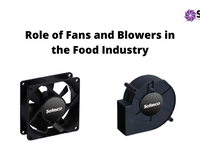

Modern electronics generate more heat as power density increases, and thermal management is essential to keep component temperatures within safe operating ranges and prevent performance loss or premature failure. In that context, a temperature-controlled fan is not just a comfort feature; it is an engineering control that helps match airflow to actual thermal demand instead of running at full speed all the time. Sofasco’s DC axial fan line is available in 5V, 12V, 24V, and 48V options, with sizes from 25 mm to 172 mm, making it suitable for a wide range of OEM, industrial, and commercial cooling applications.
A temperature-controlled fan, also called a temperature-sensing fan, fan with temperature sensor, or thermal controlled fan, solves this problem by automatically adjusting airflow based on real-time temperature conditions. Using a built-in or external thermistor, the fan’s internal control circuitry changes motor RPM as temperatures rise or fall. The result is precision cooling, lower acoustic noise, better energy efficiency, and improved equipment lifespan.
How Temperature-Sensing Fans Work
A temperature sensing fan relies on a thermistor, a temperature-sensitive resistor whose electrical resistance changes predictably with heat. In most DC brushless fan designs, this temperature signal is translated into a control response that adjusts speed automatically.
The process is simple:
- Temperature detection: The thermistor senses heat either in the fan hub or on a remote lead placed near a hotspot such as a heatsink, transformer, or processor.
- Signal processing: The fan’s internal circuit interprets the temperature change.
- Speed adjustment: Fan RPM increases or decreases to match thermal demand.
- Continuous feedback: The fan keeps adapting in real time without manual intervention.
This is what makes automatic fan speed control effective in electronics: the fan responds only when cooling is needed, rather than running at full speed all the time.
Sofasco DC Temperature-Control Options
For supported DC fan models, Sofasco offers temperature-based speed control through the “-T” suffix. This built-in temperature control option uses an internal thermistor so the fan can autonomously reduce RPM when ambient temperature drops and increase RPM as temperature rises.
Sofasco also offers Thermal Speed Control, where fan speed follows a defined temperature curve. A typical operating profile is:
- Below 25°C: fan runs at about half speed
- 25°C to 45°C: speed ramps linearly with temperature
- Above 45°C: fan runs at full speed
This kind of variable speed cooling fan is especially useful when the system load changes throughout the day or when quieter operation is preferred during low-load conditions.
Thermistor Placement: Hub Mount vs. Remote Mount
The location of the thermistor determines what temperature the fan responds to, and Sofasco offers both options.
Hub mount: The thermistor is mounted in the fan hub and senses the temperature of air passing through the fan. This is primarily recommended when the fan is exhausting air out of an enclosure, because the exiting air temperature reflects the system’s internal heat.
Remote / lead mount: The thermistor is placed on a wire lead and can be positioned directly on a hotspot such as a processor, transformer, power module, or heatsink. This is the better choice when a specific component is the thermal bottleneck.
In short, hub mounting is ideal for exhaust-air sensing, while remote mounting is better for targeted hotspot monitoring.
Types of Temperature-Controlled Fans
Temperature-controlled fans are categorized primarily by how they sense temperature and how they regulate fan speed.
By sensing method
-
Built-in thermistor fans
use an integrated sensor inside the fan assembly to monitor ambient temperature and adjust RPM automatically. Sofasco’s DC “-T” option falls into this group.
-
External thermistor fans
use a sensor mounted on a lead wire, allowing the fan to respond to a specific hotspot instead of general ambient air.
By speed-control method
-
PWM-controlled fans
use pulse-width modulation to regulate RPM with high precision. This is a speed-control method, not a temperature sensor.
-
Voltage-controlled fans
adjust speed by varying the DC supply voltage. This is simpler, but less precise at very low speeds.
This distinction matters: temperature sensing determines when speed changes, while PWM or voltage control determines how speed changes.
PWM vs. Voltage Control: Which Is Right for Your Application?
When specifying an automatic fan speed control system, engineers often choose between PWM and analog voltage control.
| Feature | PWM Control | Voltage Control |
|---|---|---|
| Operating method | Digital duty-cycle signal | Varying DC supply voltage |
| Speed precision | Very high | Moderate |
| Low-speed stability | Excellent | Can stall at low voltage |
| Efficiency | High | Lower |
| Noise optimisation | Excellent | Good |
| Wiring complexity | Higher | Lower |
| Best for | Precision cooling, servers, telecom, industrial electronics | Simpler, cost-sensitive systems |
PWM control is usually the better choice for high-density electronics, servers, telecom equipment, and systems that need verified, precise fan speed control. Voltage control is more suitable for simpler designs where cost and wiring simplicity matter more than fine RPM accuracy.
Why Temperature-Sensing Fans Matter in Electronics
As power density rises and form factors shrink, unmanaged thermal buildup is one of the leading causes of premature component failure. A temperature sensing fan addresses the core problem: fixed-speed fans waste energy and generate unnecessary noise at all times, while an adaptive fan with a temperature sensor scales its effort to the actual thermal load.
Key engineering and operational benefits:
- Prevents Overheating and Thermal Failure: Real-time thermal response prevents heat buildup before it reaches damaging levels.
- Reduces Performance Throttling: Processors and power electronics can maintain peak output when cooling is matched to load.
- Extends Component Lifespan: Operating within safe temperature windows reduces electromigration, dielectric stress, and capacitor degradation.
- Lowers Acoustic Noise: Running at half speed or below during low-load conditions produces significantly less noise, critical for medical, office, and consumer environments.
- Cuts Energy Consumption: Fan power scales with RPM cubed a fan running at 70% speed uses less than 35% of full-speed power.
- Ensures Standards Compliance: Sofasco cooling solutions are engineered to comply with RoHS, UL, CE, and ETL requirements.
Real-World Example: In outdoor telecom enclosures subject to fluctuating solar thermal loads, replacing fixed-speed units with temperature-controlled fans has been shown to reduce enclosure cooling energy by over 20% while extending battery MTBF (Mean Time Between Failures).
Key Applications of Temperature-Sensing Fans
Temperature-controlled cooling is used across many electronic systems where heat levels vary during operation.
- Computer systems and servers use temperature sensing DC axial fans for precision cooling under fluctuating processing loads.
- Telecommunications equipment such as routers, switches, and base stations depends on high-airflow axial fans and blowers for stable cooling in dense environments.
- Industrial automation systems use high static pressure blower fans in control panels, PLC enclosures, and motor drives where airflow is restricted.
- Medical electronics benefit from low-noise, high-reliability cooling in diagnostic and imaging systems.
- Consumer electronics such as gaming consoles and smart devices use variable speed cooling fans to balance performance, power efficiency, and acoustics.
- Automotive and EV systems require rugged DC fans that respond to operating temperature without manual intervention.
- LED lighting and power electronics use compact axial fans to extend component life and stabilize heat-sensitive systems.
- Renewable energy systems such as solar inverters and battery storage units rely on temperature-controlled axial and blower fans for efficient thermal management.
Specifying the Right Temperature-Control Setup
If you are selecting a precision cooling solution, the best results come from matching the fan to the application.
Start by defining the thermal load and airflow requirement. Then consider whether you need a DC fan with Sofasco’s “-T” temperature control option, a Thermal Speed Control model, a PWM fan, or a simpler voltage-controlled fan.
Also specify:
- Fan family: AC, DC, or EC
- Voltage: 12V, 24V, or 48V
- Size: physical fan dimensions
- Measurement zone: ambient air or a specific hotspot
- Sensor placement: hub mount or remote lead
For restricted enclosures, dense heatsinks, or filtered housings, static pressure is just as important as CFM. A fan with the right pressure curve will cool more effectively than one that only looks strong on airflow specs.
Engineering Guide: How to Calculate Cooling Needs
To achieve reliable precision cooling, engineers must evaluate several factors beyond physical size.
A common sizing estimate is:
CFM = Q / (ΔT × 1.76)
Where:
- Q = heat dissipated in Watts
- ΔT = allowable temperature rise above ambient in °C
This is a practical starting point for airflow sizing, but it should be validated against the actual enclosure design, airflow path, and pressure resistance.
After airflow is estimated, evaluate static pressure. In restricted enclosures, dense heat sinks, or filtered systems, airflow resistance can reduce cooling effectiveness. In those cases, a high static pressure blower fan or a properly selected axial fan may perform better than a high-CFM fan with weak pressure capability.
Common Mistakes to Avoid
Even a well-designed cooling system can underperform if the setup is wrong.
- Poor sensor placement can introduce thermal lag and delay fan response. The thermistor should be close to the dominant heat source whenever hotspot control matters.
- Ignoring airflow paths is another common error. Blocked vents, recirculating hot air, and poor internal baffling can undermine even the best fan selection.
- Underspecifying at low loads can also create problems. Some fans may not start reliably at very low speeds, especially in voltage-controlled designs.
- Choosing cost over reliability often leads to higher maintenance costs later. In applications with high MTBF expectations, quality bearings and stable thermistor behavior matter.
Why Choose Sofasco
Sofasco manufactures and engineers’ precision cooling solutions for demanding electronic and industrial applications. Our DC fan portfolio includes the "-T" (Temperature Control) option with built-in thermistor autonomy, Thermal Speed Control fans with defined linear speed curves (25°C-45°C ramp), and 4-wire PWM-controlled DC axial fans for system-integrated cooling.
Our product range spans AC axial fans, DC axial fans, EC axial fans, and high-static-pressure DC blowers available in voltages from 12V to 48V and sizes from 25mm to 254mm. All products are certified to RoHS, UL, CE, and ETL standards. To get the right temperature-control configuration for your application specify fan type (AC/DC/EC), voltage, size, and thermistor placement preference (hub mount for exhaust sensing; remote lead for hotspot monitoring) contact the Sofasco engineering team directly.
FAQs
Q1. How do I determine the correct airflow requirement for a temperature-controlled fan system?
Airflow should be calculated based on total heat dissipation (in watts), enclosure volume, and allowable temperature rise. Thermal simulation or empirical testing is often used in precision electronic designs to finalize CFM requirements.
Q2. Can multiple temperature sensor fans be synchronized in one system?
Yes, multiple fans can be synchronized using a shared PWM controller or centralized thermal management system, allowing coordinated airflow response across larger or multi-zone enclosures.
Q3. What factors affect the response time of a temperature sensing fan?
Response time depends on sensor placement, thermal mass of surrounding components, controller processing speed, and the sensitivity of the thermistor or digital sensor used.