
AI is changing the way data centers are designed and cooled. Modern AI servers can pack high-power GPUs, CPUs, memory, networking hardware, and power electronics into compact systems. More computing power means more heat, and that heat has to be removed reliably to keep equipment operating within its required temperature range.
This is why AI data center cooling has become an important consideration for data center operators, OEMs, and equipment designers. Liquid coolingis becoming increasingly important for high-density AI systems, but that does not mean air cooling and fans have disappeared. Depending on the system design, fans may still be needed for networking equipment, memory, power electronics, storage, enclosures, and other components.
The right cooling approach depends on the equipment, heat load, rack density, and overall system architecture.
Why Do AI Servers Generate So Much Heat?
AI servers generate heat primarily because electrical power used by processors and other electronics is converted into thermal energy.
Several factors make AI systems particularly challenging to cool:
- High-power GPUs and CPUs: AI workloads can place substantial demand on processors and accelerators. GPUs and CPUs perform intensive AI calculations, consuming significant electrical power that is ultimately released as heat.
- Sustained workloads: Training and inference can keep computing hardware operating at high utilization for extended periods.
- High component density: Multiple processors, accelerators, memory modules, and other components are installed within compact server enclosures, concentrating more heat in increasingly limited spaces.
- Higher rack density: More powerful servers can significantly increase the total heat generated within a rack.
As rack densities increase, traditional air cooling can become more difficult to manage. Current ASHRAE guidance recommends considering liquid or liquid-assisted cooling architectures for high-density AI deployments while continuing to use air cooling where it remains appropriate.
How Does Data Center Air Cooling Work?
Data center air cooling uses conditioned air to carry heat away from IT equipment. At the equipment level, fans move air through the server. The air passes heat-generating components, absorbs heat, and exits the equipment at a higher temperature.
At the facility level, equipment such as CRAC or CRAH units and other cooling infrastructure removes heat from the air and maintains the required environmental conditions. Effective airflow management is also important. Hot-aisle/cold-aisle layouts and containment help prevent hot exhaust air from mixing with cool supply air.
For the equipment itself, designers must consider restrictions caused by:
- Heat sinks
- Filters
- Grilles
- Ducts
- Narrow airflow passages
- Cable routing
- Enclosure geometry
These restrictions create pressure losses, which is why fan selection should consider both airflow and static pressure.
Where Are Cooling Fans Used in AI Data Center Cooling?
Cooling fans are critical wherever AI infrastructure or supporting equipment relies on forced-air cooling. Depending on the cooling architecture, they may support airflow within:
- AI Servers: Fans move air through server chassis to cool components such as memory, power electronics, networking hardware, and other onboard components.
- Supporting Equipment: Fans can also provide forced-air cooling for power and electronics cabinets, control equipment, and other assemblies used alongside AI infrastructure.
- Hybrid Systems: Fans can work alongside liquid cooling to provide airflow to components that are not directly cooled by the liquid-cooling system.

Do AI Servers Still Need Cooling Fans?
It depends on the cooling architecture. In a conventional air-cooled server, fans are an essential part of the cooling path. In a liquid-cooled system, liquid may remove heat directly from high-power CPUs or GPUs. However, other components may still require air cooling. Hybrid systems can therefore use liquid cooling for the highest-power components while fans provide airflow for components outside the liquid loop.
ASHRAE's current AI data-center guidance specifically describes hybrid architectures in which direct-to-chip liquid cooling handles high-power processors while air cooling manages residual heat from components such as memory, storage, power supplies, and networking equipment. >
At the same time, some newer AI architectures are moving toward fully liquid-cooled designs. NVIDIA's 2026 Rubin architecture, for example, is described as 100% liquid cooled with no fans in the system. So the role of fans is changing but they remain relevant wherever forced-air cooling is part of the equipment design.
Air Cooling vs. Liquid Cooling in Data Center Cooling Systems
Air and liquid cooling solve the same basic problem, removing heat, but they do it differently
|
Consideration |
Air Cooling |
Liquid Cooling |
|
Heat transfer |
Air passes across components and carries away heat. |
Liquid absorbs heat close to high-power components. |
|
Main components |
Fans, blowers, heat sinks, air paths, and air-handling equipment. |
Cold plates, pumps, tubing, CDUs, heat exchangers, and controls. |
|
Typical fit |
Equipment that can effectively reject heat through airflow. |
Components with higher or more concentrated thermal loads. |
|
Infrastructure |
Works with the facility's air-distribution and cooling systems. |
Requires a liquid distribution and heat-rejection system within the cooling architecture. |
|
Typical application |
Conventional servers and electronic equipment |
High-density AI/HPC systems |
|
Main strength |
Established and practical for many systems |
Handles concentrated, high-density heat loads effectively |
There is no single cooling method for every data center cooling system. Many facilities will use a combination of air-cooled and liquid-cooled equipment.
What Types of Fans Are Used for AI Server Cooling?
Fan selection depends on airflow, pressure, available space, electrical requirements, controls, noise, and environmental conditions.
Axial Fans
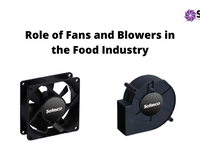
Axial fans move air primarily along the axis of rotation. They can be useful where high airflow is required within a relatively compact space. Typical applications include server chassis, networking equipment, electronic enclosures, and other equipment requiring forced-air cooling.
Centrifugal Fans and Blowers
Centrifugal fans draw air into an impeller and discharge it radially. They can be useful where the airflow path has greater resistance, such as systems with restrictive channels, filters, heat sinks, or ducts.
EC Fans
EC, or electronically commutated, technology refers to the motor and control system rather than a specific fan shape. EC fans can support variable-speed operation and electronic control, making them useful when airflow requirements change with equipment load or temperature.
Fan selection depends on airflow, pressure, available space, electrical requirements, controls, noise, and environmental conditions. For server-level cooling, engineers typically evaluate three related parameters together: fan size, rotational speed (RPM), and airflow (CFM). Fan size determines the physical envelope available for the cooling solution, while RPM influences the amount of air the fan can move and the pressure it can generate. The required CFM should be determined from the equipment's heat load and allowable temperature rise rather than selecting a fan based only on its maximum airflow rating.
Control, Monitoring, and Redundancy
Speed control matters when heat load varies. Airflow scales roughly with fan speed, static pressure with speed squared, and power with speed cubed. This means that operating a fan below its maximum RPM can reduce power consumption when the full airflow capacity is not required. For AI and server applications, variable-speed control can therefore allow the cooling system to respond to changing processor and system loads rather than continuously operating the fan at maximum speed.
The required operating RPM should be determined from the fan's performance curve and the system's resistance curve. Sofasco offers PWM speed control, a temperature-control option (-T), a tachometer output (-FG, two pulses per revolution), and a locked-rotor alarm (-RD); the -T, -FG, and -RD options are for DC fans only. For 24/7 equipment.
How to Select a Fan for AI Data Centers
Choosing a fan starts with the cooling requirement and then works through the conditions the fan must handle. Evaluate the complete airflow path rather than selecting a model based on its maximum airflow rating alone. Here are the key factors to consider:
- Define the heat load: Establish the amount of heat the equipment needs to dissipate and the allowable temperature rise. This sets the basis for determining the required airflow.
- Determine the airflow requirement: Calculate the airflow needed to dissipate the required heat within the specified temperature range.
- Consider fan size and operating speed: Larger fans can often deliver the required airflow at lower RPM, while smaller fans may require higher RPM. Fan size and speed should be selected based on available space, airflow, pressure requirements, noise, and power consumption.
- Account for system resistance: Identify pressure losses from heat sinks, filters, grilles, ducts, heat exchangers, and other restrictions. These losses determine the pressure the fan must overcome at the required airflow.
- Verify the operating point: Use the fan and system curves to confirm that the selected model delivers the required airflow at the application's operating pressure. Avoid relying on free-air CFM as the sole performance measure.
- Evaluate the fan curve: Rated free-air CFM does not represent actual installed airflow. Verify the required CFM and static pressure against the fan curve, especially where heat sinks, filters, grilles, cables, or narrow passages increase system resistance.
- Check physical, electrical, and operating requirements: Confirm dimensions, mounting, airflow direction, clearance, voltage, control method, ambient conditions, duty cycle, acoustic requirements, and expected service life.
Sofasco's custom-engineered fan offering includes options for requirements such as dimensions, airflow, voltage, bearing type, IP rating, noise, mounting, PWM, temperature control, and other application-specific features. Sofasco custom-engineered cooling fans
Where Do Sofasco Fans Fit Into AI and Data Center Cooling?
Sofasco™ International provides cooling fans and forced-air cooling solutions for electronic and industrial applications. Its portfolio includes AC, DC and EC fan technologies, including axial fans, centrifugal fans, blowers, crossflow fans, telecom fans, and other cooling solutions. Sofasco also provides custom-engineered fan options for applications with specific mechanical, electrical, airflow, environmental, and control requirements.
For OEMs and equipment designers, this can be particularly useful when a standard fan does not meet the complete application requirement. The key is to evaluate the fan as part of the complete thermal system including heat load, airflow path, pressure resistance, controls, physical constraints, and operating environment.
Frequently Asked Questions
Q1. Do AI data centers always need liquid cooling?
No. Cooling requirements depend on rack density, server design, component power, and facility architecture. High-density AI systems increasingly use liquid or hybrid cooling, while air cooling remains suitable for many lower-density and supporting applications.
Q2. Can air cooling handle AI servers?
Yes, depending on the server and rack thermal load. As density increases, however, liquid cooling may become necessary or more practical for removing concentrated heat.
Q3. Do liquid-cooled AI servers still need fans?
Some do. Hybrid systems can use liquid cooling for high-power processors while fans cool other components. Fully liquid-cooled systems may eliminate fans from the primary IT cooling path.
Q4. What is better for server cooling: CFM or static pressure?
Both are important. CFM measures airflow, while static pressure indicates how effectively the fan can overcome system resistance. The correct fan must provide the required airflow at the application's operating pressure.
Q5. What type of fan is best for server cooling?
There is no universal answer. Axial fans can suit high-airflow applications, while centrifugal fans and blowers can be useful where greater pressure capability is required. The choice depends on the complete application.
Conclusion
AI is pushing data-center thermal requirements higher, but the future of cooling is not simply about choosing between fans and liquid cooling. High-density AI systems are increasingly adopting direct-to-chip and other liquid-cooling technologies, while air cooling continues to play an important role in many servers, networking systems, power electronics, and hybrid architectures.
For engineers and OEMs, effective cooling starts with understanding the complete thermal requirement: heat load, airflow, static pressure, system resistance, physical constraints, controls, and operating environment. When forced-air cooling is required, choosing the right fan is about more than maximum CFM. The fan needs to work with the entire system.
Need help identifying a cooling fan for your equipment? Share your airflow, pressure, voltage, dimensions, and application requirements with Sofasco to discuss a suitable cooling solution.