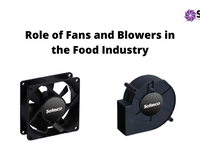

Fans and blowers may seem the same to most people, and at times may be used interchangeably. However, fans and blowers are technically different in terms of their working, structure, function, and applications. But, primarily, both fans and blowers are used for cooling and air circulation either in indoor areas, HVAC systems, or inside industrial machines as well as electronic equipment. Ironically, the term blower fan is also quite widely used, especially when it comes to industrial blower fan.
Fans and blowers are both used to move air or gases, but their designs and operating characteristics can differ. In many industries, the terms are also used interchangeably.
For equipment designers and engineers, the important question is not simply whether to choose a fan or blower, but whether the selected product can provide the required airflow and pressure at the application's actual operating condition. This guide explains the key differences between fans and blowers, common types, industrial applications, and the factors to consider when selecting the right solution.
How Do Fans and Blowers Work?
Fans and blowers use a motor to rotate blades or an impeller, transferring energy to the air and creating airflow.
Axial airflow
An axial fan moves air primarily parallel to the rotating shaft. These fans are commonly used where high airflow is required through a relatively open airflow path.
Centrifugal airflow
A centrifugal fan or blower draws air toward the center of the impeller and redirects it radially outward. This configuration can be useful when air must pass through filters, heat exchangers, ducts, or other sources of system resistance.
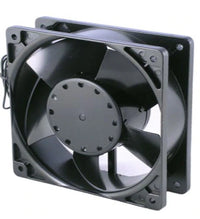
High-quality 12V, 24V, and 48V axial fans at competitive prices. Industrial high airflow axial muffin fans available in sizes 25 mm to 254 mm. Common sizes in stock: 40 mm, 52 mm, 60 mm, 80 mm, 120 mm.
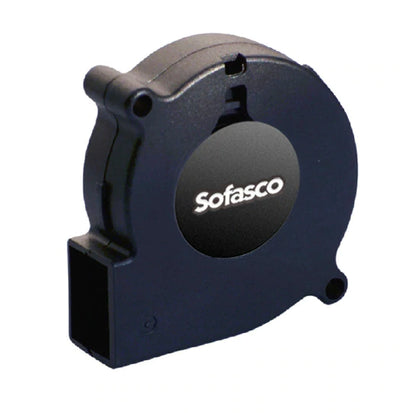
High-quality certified blower fans at cost-effective prices. Dust and waterproof industrial blower fans available in sizes 75 mm to 120 mm. Get a quote now.
How are Fans and Blowers Different from Each Other?
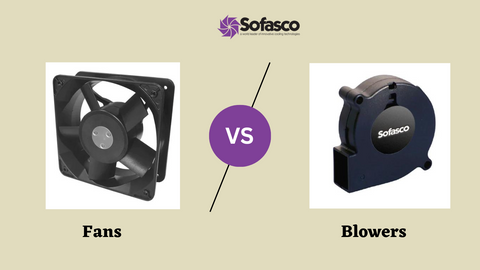
The American Society of Mechanical Engineers (ASME) has defined fans and blowers based on their discharge pressure and suction pressure ratio. This way they have also defined compressors, and in a way distinguished between all these three devices. According to ASME, a fan is a device with a pressure ratio of up to 1.11. A blower has a pressure ratio between 1.11 And 1.2. On the other hand, the pressure ratio in a compressor is more than 1.2. Any kind of ventilation device, when operational, will bring in air and throw out some air, which may also comprise dirt, dust, contaminants, and so on. Industrial blower fans may also be subjected to various oils, chemicals, fumes, high temperatures, and so on depending on the industry type. Here, we do a quick comparison of fans and blowers.
Types of Fans and Blowers
Fans and blowers can be classified primarily by how they move air and how their impeller or blade geometry develops airflow and pressure. The two major fan families are axial and centrifugal, while blower technologies also include centrifugal and positive-displacement designs.
The appropriate type of industrial fans and blowers depends on factors such as airflow, static pressure, system resistance, efficiency, space, noise, temperature, and the characteristics of the air being moved.
Types of Fans
1. Axial Fans
Axial fans move air primarily parallel to the rotating shaft, like the airflow generated by an aircraft propeller. They are commonly used when substantial airflow is required and the system does not impose very high resistance.
The three common axial fan configurations are propeller, tubeaxial and vaneaxial fans.
Propeller Fans: Propeller fans use relatively simple blades mounted around a hub and are generally suited to high-volume, low-pressure airflow.
Typical applications include:
- General ventilation
- Air circulation
- Equipment ventilation
- Exhaust applications
- Large open-air spaces
They are relatively simple in construction, but their pressure capability and efficiency are generally limited compared with more advanced axial or centrifugal designs.
Tubeaxial Fans: Tube axial fans place the axial impeller inside a cylindrical housing. The housing helps control the airflow and allows the fan to develop more useful static pressure than a basic propeller fan.
They are commonly considered for:
- Ducted ventilation
- Industrial exhaust
- Equipment cooling
- Process ventilation
AMCA describes tube axial fans as generally more efficient and capable of developing more useful static pressure than basic propeller fans.
Vaneaxial Fans: Vane axial fans incorporate guide vanes before or after the impeller to improve airflow characteristics and pressure development.
They can provide medium-to-high pressure capability with good efficiency, depending on the blade and guide-vane design.
Typical applications include:
- Industrial ventilation
- HVAC systems
- Tunnel ventilation
- Process air movement
- Large equipment cooling
Guide vanes help recover or redirect airflow energy and can increase pressure capability and efficiency.
2. Centrifugal Fans
Centrifugal fans draw air into the impeller primarily in an axial direction and discharge it radially outward, approximately perpendicular to the inlet direction. The impeller geometry determines much of the fan's pressure, efficiency and operating characteristics. Centrifugal fans are widely used in industrial applications because they can provide substantial pressure capability and can be configured for different operating requirements.
The major centrifugal fan configurations include forward-curved, backward-curved/backward-inclined, and radial fans.
Forward-Curved Fans: Forward-curved blades curve in the direction of wheel rotation.
They are commonly used for high airflow at relatively low pressure and can provide a compact solution where low operating speed and relatively low noise are important.
Typical applications include:
- Residential and commercial HVAC
- Air-handling equipment
- Compact ventilation systems
- Equipment cooling
Forward-curved fans generally have lower efficiency than backward-curved or airfoil designs and are typically intended for cleaner air applications.
Backward-Curved and Backward-Inclined Fans: Backward-curved or backward-inclined blades curve away from the direction of rotation. These designs are commonly selected when efficiency, pressure capability, and stable performance are important. Airfoil versions can provide particularly high efficiency.
Applications include:
- Commercial HVAC
- Air-handling units
- Industrial ventilation
- Clean-air systems
- Process applications
AMCA identifies airfoil, backward-inclined and backward-curved designs among the major centrifugal impeller configurations, with airfoil and backward designs generally offering higher efficiency than forward-curved designs.
Radial Fans: Radial fans use blades extending primarily outward from the impeller.
Their relatively robust wheel design makes them suitable for applications involving dust, particulates or harsher airstreams, where minimizing material buildup on the blades can be important.
Typical applications include:
- Industrial ventilation
- Dust collection
- Material handling
- Process exhaust
- Particulate-laden airflow
Radial fans generally trade some efficiency and acoustic performance for durability and resistance to demanding air conditions.
3. Cross-Flow or Tangential Fans
Cross-flow fans use a long cylindrical impeller to generate airflow across the width of the fan. Instead of directing air primarily along the shaft like an axial fan, they create a broad, relatively uniform airflow pattern across the outlet.
They are useful when a long or distributed airflow is required within a compact space.
Common applications include:
- Air conditioners
- Air curtains
- Electronics
- Appliances
- Heating equipment
- Industrial equipment
For compact equipment, cross-flow fans can provide an effective way to distribute airflow across a relatively large area.
Types of Blowers
The term blower covers several different air-moving technologies. For industrial process applications, blower selection is generally based on the required flow rate, pressure, operating hours, efficiency and process conditions rather than simply choosing the highest-rated blower.
Two broad categories are centrifugal/dynamic blowers and positive-displacement blowers.
1. Centrifugal Blowers
Centrifugal blowers use a rotating impeller to accelerate air outward and convert velocity into pressure. They are commonly used for applications requiring controlled airflow through a system with measurable resistance.
Depending on the design, centrifugal blower technologies can include:
• Single-stage centrifugal designs
• Multistage centrifugal blowers
• High-speed turbo blowers
These technologies are used in applications such as:
• Industrial ventilation
• Wastewater aeration
• Pneumatic conveying
• Process air
• Material drying
• Cooling and heating processes
Modern industrial blower manufacturers commonly distinguish centrifugal/turbo technologies from positive-displacement lobe and screw technologies based on the required flow and pressure range.
2. Positive-Displacement Blowers
Positive-displacement blowers operate differently from centrifugal machines. Instead of continuously accelerating air through an impeller, they trap and move defined volumes of air and deliver that air against system resistance.
Difference Between Fan and Blower
| Fan | Blower |
|---|---|
| Has blades for functioning or rotation | Has impellers for rotation |
| Is an electrical device | Is a mechanical device |
| It consumes less electricity | This relatively consumes more power |
| It offers medium airflow depending on the capacity | It offers better airflow than fans |
| Some types include radial fans, industrial axial fans, and propeller fans | The two main categories are centrifugal and positive displacement blowers |
Why Choose Sofasco for Fans and Blowers Solutions
At Sofasco, we are an experienced industrial fan and blower manufacturer providing AC, DC, and EC air-moving solutions for industrial, commercial, and OEM applications. Since 1981, we have developed air-moving solutions including axial fans, centrifugal fans, cross-flow fans, and blowers for diverse cooling and thermal-management requirements. Our engineering capabilities also support application-specific and customized fan solutions based on airflow, voltage, dimensions, and operating requirements. Contact Sofasco to discuss your application or request a quote for the right fan or blower solution.
FAQs
Q1. What is the main difference between a fan and a blower?
Both move air or gas. Their differences generally relate to design, airflow direction, pressure characteristics and the application in which they are used.
Q2. Are centrifugal fans and blowers the same?
The terminology can overlap. Many centrifugal blowers operate using the same basic centrifugal airflow principle as centrifugal fans.
Q3. Is a blower more powerful than a fan?
Not necessarily. Performance depends on the specific design, airflow, pressure, motor and operating point.
Q4. What are the main types of industrial fans and blowers?
Common types include axial fans, centrifugal fans, centrifugal blowers and cross-flow fans.
Q5. How do I select the right fan or blower?
Start with the required airflow and static pressure, then evaluate system resistance, dimensions, voltage, noise, efficiency and environmental conditions.