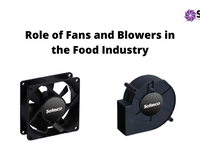

Centrifugal fans, also commonly referred to as centrifugal blowers, are widely used in industrial, commercial, and electronic cooling applications where controlled airflow and pressure are required. Among the different types of centrifugal fans, forward curved and backward curved centrifugal fans are the most commonly specified designs.
In this blog post, we will explore the comparison between forward curved and backward curved centrifugal fans, which helps to take decision when choosing the ideal fan for your application. By understanding the differences, advantages, and limitations of these fan types, you can optimize your airflow systems for optimal performance. This comparison helps engineers and system designers understand the key differences, characteristics, and selection criteria for forward curved and backward curved centrifugal fans and blowers.
What Are Centrifugal Fans Used For?
Centrifugal fans are designed to move air outward from the impeller using centrifugal force, making them ideal for applications that require higher pressure or ducted airflow. Unlike axial fans, they perform efficiently against resistance such as filters, heat exchangers, and long duct runs. As a result, centrifugal fans/Blowers are widely used in HVAC systems, electronics and power electronics cooling, data centers, cleanrooms, industrial ventilation, and energy infrastructure, including BESS, EV chargers, UPS systems, and inverter cabinets. They are also well-suited for dust extraction and industrial process air handling where controlled, reliable airflow is required.

Forward Curved Cooling Fans
Forward curved centrifugal fans, also known as squirrel cage fans, are a type of centrifugal fan/blower commonly used in various applications. They feature a curved blade design where the blades curve in the direction of the fan's rotation. This design creates a paddlewheel-like appearance, resembling a squirrel cage, hence the name. The blades are typically mounted on a hub, and the fan assembly is housed within a circular or rectangular casing.
Advantages:
- High Airflow Capacity: Forward curved fans are known for their excellent airflow capacity. The curved blade design allows for efficient movement of large volumes of air, making them suitable for applications that require substantial air circulation.
- Lower Noise Levels: Compared to other fan types, forward curved fans tend to operate at lower noise levels. The curved blades help to minimize turbulence and reduce noise generation, making them suitable for environments where noise reduction is a priority.
- Cost-Effective: Forward curved centrifugal fans are often more cost-effective compared to other fan types. Their simpler design and manufacturing process contribute to lower production costs, which can make them a budget-friendly choice for various applications.
Limitations:
- Lower Efficiency at Higher Pressures: As the pressure increases, the fan's ability to maintain optimal performance decreases, resulting in reduced airflow and efficiency. Therefore, forward-curved centrifugal fans may not be suitable for applications that require high static pressure capabilities.
- Limited Static Pressure Capabilities: Forward curved fans are better suited for applications with relatively low static pressure requirements. Their design is optimized for delivering high airflow volumes but may struggle to generate significant pressure differentials. Thus, they may not be the best choice for applications where overcoming high resistance or pressure drops is essential.
-
Overloading power characteristics: Forward curved fans exhibit overloading power characteristics, meaning motor power increases rapidly as system pressure rises. If system resistance changes, this can lead to motor overheating or failure.
-
Efficiency decreases significantly at higher static pressures, making forward curved centrifugal fans unsuitable for high-resistance ducted systems or variable operating conditions.
Applications for Forward Curved Centrifugal Fans:
Forward curved fans find their best applications in scenarios that prioritize high airflow capacity, moderate pressure requirements, and noise reduction. Some common applications where forward curved fans are commonly used include:
- HVAC systems: Forward curved fans are widely used in heating, ventilation, and air conditioning systems, providing efficient airflow for cooling and ventilation purposes in commercial and residential buildings.
- Air handling units: These fans are often employed in air handling units to circulate air within industrial and commercial facilities, ensuring proper ventilation and maintaining air quality.
- Electronics cooling: Forward curved fans are suitable for cooling electronics and preventing heat build-up in components such as computers, servers, and electronic enclosures.
- General ventilation: They can be utilized for general ventilation purposes in warehouses, factories, gyms, and other large spaces that require adequate air movement.

Backward Curved Cooling Fans
Backward curved centrifugal fans are another type of centrifugal fan commonly used in various industrial and commercial applications. Unlike forward curved fans, backward curved fans have blades that curve away from the direction of the fan's rotation. The blades are typically larger and more curved, allowing for more efficient airflow and pressure generation. Backward curved fans are typically housed in a circular or rectangular casing.
Advantages:
- Higher Efficiency: Backward curved centrifugal fans are known for their higher efficiency compared to forward curved centrifugal fans. The curved blade design, combined with the larger blade size, enables better airflow control and reduces energy losses, resulting in improved overall efficiency.
- Better Performance at Higher Pressures: Unlike forward curved fans, backward curved fans excel at higher pressure applications. They can handle increased resistance and pressure drops while maintaining their performance and airflow capacity. This makes them suitable for applications that require higher static pressure capabilities.
- Suitable for Clean Air and Dusty Environments: Backward curved fans are well-suited for applications in clean air and dusty environments. The curved blade design helps to minimize the accumulation of dust and debris on the blades, reducing the risk of performance degradation due to contamination. This makes them ideal for applications that demand clean air circulation, such as cleanrooms or industrial processes that generate dust.
-
Non-overloading power characteristics: Backward curved centrifugal fans feature non-overloading power characteristics, which protect the motor even when system pressure varies.
-
low energy consumption: Higher aerodynamic efficiency results in lower energy consumption, especially in continuous-duty and long operating-hour applications.
-
Variable-speed control: Well-suited for use with EC motors and variable-speed control, enabling precise airflow regulation and additional energy savings.
Limitations:
-
Higher Noise Levels: One of the limitations of backward curved centrifugal fans is that they tend to generate more noise compared to forward curve fans. The larger blades and higher airflow capacity can result in increased turbulence and noise production. However, advancements in fan design and technology have led to the development of quieter models, mitigating this limitation to some extent.
-
Higher Cost: A backward curved blower is generally more expensive than a forward curved Blower. The larger blades and higher manufacturing complexity contribute to the higher cost. However, it's important to consider the long-term benefits and efficiency gains that backward curved fans offer, which can outweigh the initial investment.
Applications for Backward Curved Centrifugal Fans:
Backward curved fans are well-suited for applications that require higher efficiency, better performance at higher pressures, and clean air circulation. Some common applications where backward curved fans are commonly used include:
- HVAC systems: Backward curved fans are often used in HVAC systems for improved energy efficiency and higher static pressure capabilities.
- Cleanrooms: These fans are suitable for maintaining clean air in controlled environments where contamination must be minimized.
- Industrial processes: Backward curved fans find application in industrial processes where high airflow and pressure capabilities are necessary, such as air pollution control systems or industrial ventilation.
- Data centers: Data centers utilize backward curved fans for efficient cooling and airflow management in server rooms.
Comparison between Forward Curved VS Backward Curved Fans
| Parameter | Forward Curved Fans | Backward Curved Fans |
|---|---|---|
| Airflow | High | Controlled & stable |
| Static pressure | Low–Medium | Medium–High |
| Efficiency | Lower | Higher |
| Motor loading | Overloading | Non-overloading |
| Dust handling | Poor | Better |
| Typical use | HVAC, clean air | Industrial, continuous duty |
Factors to Consider When Choosing Between Forward Curved and Backward Curved Centrifugal Fans
Selecting the right fan for your application involves considering various factors that align with your specific requirements. Here are some key factors to consider when choosing between forward curved and backward curved fans:
- Airflow Requirements: Evaluate the airflow volume needed for your application. Forward curved fans are generally better suited for high airflow capacity, making them suitable for applications that prioritize air circulation. Backward curved fans, on the other hand, offer better airflow control and efficiency, making them ideal for applications that require precise airflow management.
- Pressure Requirements: Backward curved centrifugal fans excel in higher pressure applications, making them suitable for overcoming resistance and pressure drops. If your application requires significant pressure differentials, a backward-curved fan may be more appropriate. However, if your pressure requirements are relatively low, a forward curved fan may suffice.
- Noise Considerations: Forward curved centrifugal fans tend to operate at lower noise levels compared to backward curved fans. If noise reduction is a priority, particularly in settings such as residential or office spaces, forward curved fans may be a more suitable choice. However, advancements in fan design and technology have led to quieter backward curved fan models as well.
- Environmental Conditions: Forward-curved fans are generally more suitable for clean air environments, while backward-curved fans are better equipped to handle dusty environments. If your application involves dusty or contaminated air, a backward curved fan may be preferable to minimize the risk of performance degradation due to debris accumulation.
- Cost Considerations: Forward curved fans are generally more cost-effective in terms of initial investment, while backward curved fans may have a higher upfront cost. However, backward curved fans often offer higher efficiency, better performance, and longer-term energy savings, which can offset the initial investment over time.
By carefully considering these factors and aligning them with your specific application requirements, you can make an informed decision on whether a forward curved or backward curved fan is the most suitable choice for your needs. Sofasco specializes in designing and manufacturing industrial fans in varied specifications, such as axial fans, centrifugal fans, cross-flow fans, blowers, and dust-proof cooling. With years of market presence and skilled employees, the company specializes in offering RoHS-compliant and UL-certified harsh environment cooling fans for your needs. Get in touch with their team to know more about these industrial fans.
FAQS
Q1.) What is the difference between forward curved and backward curved fans?
A) Forward curved centrifugal fans provide high airflow at low pressure and lower noise, while backward curved fans deliver higher efficiency, better high-pressure performance, and non-overloading motor operation.
Q2.) What is the efficiency of a forward curved fan?
A) Forward curved fans have lower efficiency than backward curved fans, especially at higher static pressures, and are best suited for low-pressure applications.
Q3.) What is the difference between a forward blower and a backward blower?
A) A forward blower moves large volumes of air at low pressure, whereas a backward blower handles higher pressure with better efficiency and motor safety.
Q4.)Which is better: forward curved or backward curved centrifugal fan?
A) Forward curved fans are better for low-pressure HVAC systems, while backward curved centrifugal fans are better for energy-efficient, high-pressure, and continuous-duty applications.
Q5.) What is the best fan curve for CPU cooling?
A) For CPU cooling, a fan with high static pressure and a stable airflow curve performs best, especially when air must pass through dense heat sinks.